What is a stress bucket?
You have probably heard about a ‘stress bucket’ and that it can influence your dog’s behavior. But what exactly is this? And why would it affect your dog’s behavior? What can you do if the bucket overflows? In this blog, we’ll take a closer look at these questions.
Stress hormones
If you are feeling well yourself, you can cope with much more. The saying, “the straw that breaks the camel’s back,” comes from somewhere. In daily life, your dog has all sorts of experiences. Both negative and positive stimuli that your dog encounters each day leads to the production of “stress hormones”—adrenaline, cortisol, and noradrenaline—in your dog’s body. These hormones trigger the “fight or flight” response and prompt your dog into action. The stimuli or experiences that cause the release of stress hormones are the drops of water that fill the stress bucket.
The stress bucket is your dog’s personal bucket. It visualizes how many stimuli your dog receives in a day and how much he can process before becoming overwhelmed and thus less responsive to you as the owner.
Properties of the stress bucket
Every dog is different, so each stress bucket is unique. What remains true is that every event adds a drop of water to the bucket. How much the bucket can hold depends on the individual dog. Not every dog has a bucket of the same size. Working dogs, such as border collies, often have a smaller bucket because they are bred to spring into action. Not every bucket is equally empty. If a dog has experienced a lot in his life, it’s quite possible that he suffers from chronic negative stress and that the bucket is already partly filled, making it more likely to overflow quickly.
A little stress is, of course, not a bad thing and is needed to function well. Think, for example, of having to finish a presentation by a certain deadline. You feel acute stress up to that deadline and then you can breathe a sigh of relief. The feeling doesn’t disappear instantly, but it lessens. Unfortunately, too much stress does have a negative effect on our functioning. We see things less clearly, perform worse, and are quicker to lose our temper. The same goes for your dog.
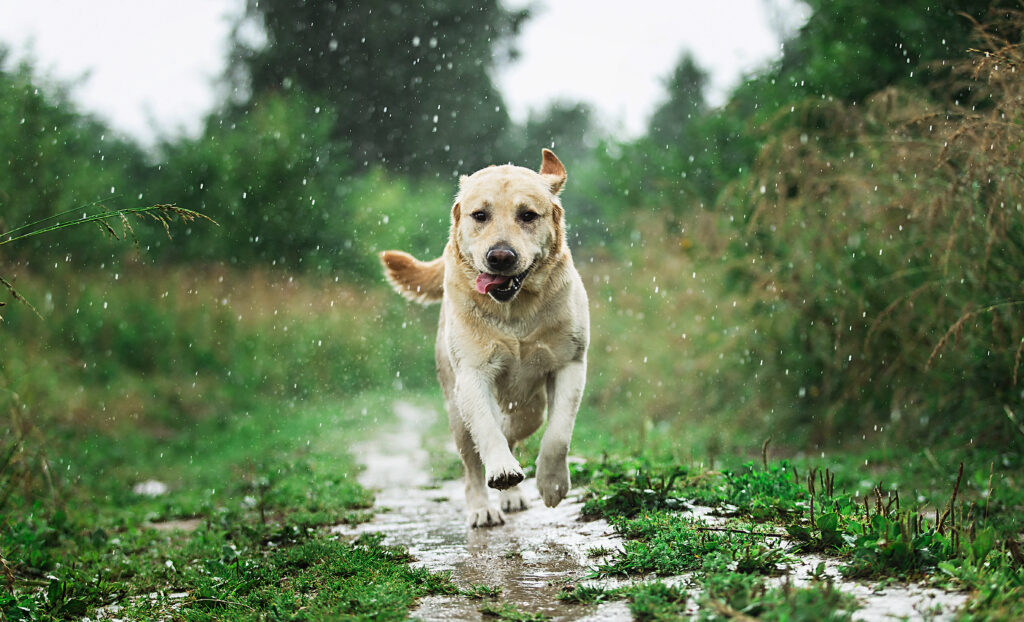
We cannot change the size of the stress bucket. That is fixed and unique to your dog. What we can influence is the number of stimuli or stressors (the drops of water) that fill the bucket and how much water evaporates from the bucket.
Reducing the stress hormones in the body
By giving your dog rest in time (the ‘safe haven’ exercise), taking your dog on a sniffing walk (the sniffing walk exercise), or providing a puzzle, snuffle mat, or licking mat, you lower the levels of stress hormones in the body, replacing them with hormones such as dopamine (the happiness hormone), endorphin (relaxation), and oxytocin (calm and connection). As a result, the water level in the stress bucket gradually drops, and your dog becomes receptive to you again. After all, his head is no longer full but is mostly empty again.